


From a simple inheritance protocol to a full suite of continuity tools, BΔLT is helping Bitcoin holders make sure their assets keep moving, no matter what happens.
Self-custody is one of Bitcoin’s greatest strengths, but it comes with a hard question: what happens to your Bitcoin if you lose access to it, or if you’re no longer around to manage it? There’s usually no recovery mechanism, no customer support line, no “forgot password” button. BΔLT was built to answer exactly that question, and on RootstockCollective, we’re proud to count them among our grantees.
We sat down with Jonathan Bravetti, founder of JXLabs and the mind behind BΔLT, to talk about the product, the journey, and why Bitcoin’s programmable layer was the only place to build it.
Jonathan Bravetti is the Founder and CEO of JXLabs, a Bitcoin innovation lab focused on building practical, non-custodial applications that expand Bitcoin’s utility beyond holding and trading. He’s a software architect and entrepreneur with more than a decade of experience designing enterprise technology solutions across Latin America, and over the years his focus shifted toward Bitcoin, blockchain infrastructure, and the challenge of making decentralized assets genuinely useful in everyday life.
That focus is also, in his own words, the simplest way to describe him.
“I am a Bitcoiner. After that, I asked myself: how can I help the Bitcoin ecosystem? So that’s what we set out to do at JXLabs.”
Jonathan leads product vision and architecture at JXLabs alongside a team working across smart contracts, backend infrastructure, frontend applications and product experience, with a strong shared focus on non-custodial design, simplicity and security.
BΔLT- short for Bitcoin Autonomous Legacy Trust – started out solving one very specific problem: decentralized inheritance. Users could create a smart contract vault, name a beneficiary, and set a time-based inactivity period so their Bitcoin could be claimed if they ever became unreachable.
As the team built it out, they realized inheritance was just one face of a bigger problem: digital asset continuity. Today, BΔLT has grown into a suite of four applications, all live on Rootstock Mainnet:
As Jonathan put it when describing the shift from a single product to a platform:
“Gifting Bitcoin is better. With BΔLT Gift, you can give Bitcoin the easy way, and hand over a gift card to go with it.”
What’s notable is how approachable the whole suite is. Vaults have a reputation for being something only large companies set up, with complex legal and technical overhead. BΔLT compresses that into a flow simple enough for an individual user to complete in minutes, without ever giving up custody of their assets.
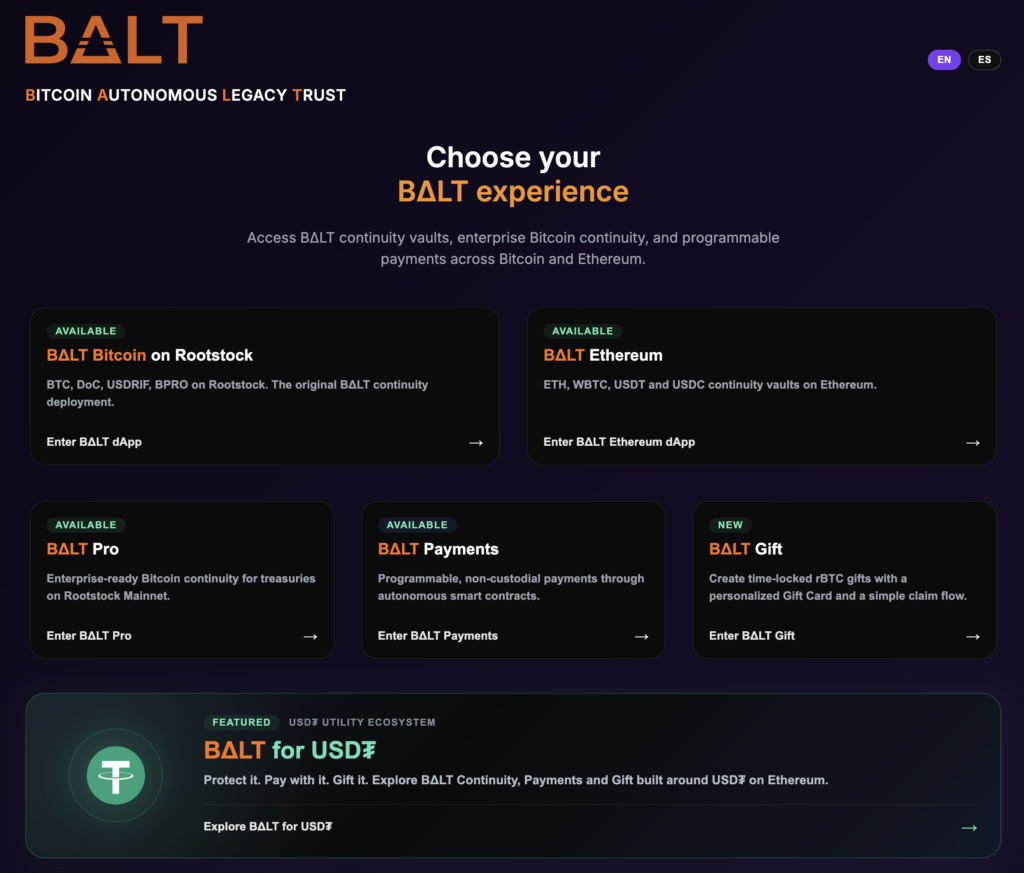
For Jonathan, the choice came down to two things Rootstock offers that few other Bitcoin-adjacent networks do: smart contracts and a Bitcoin-backed asset that actually holds a 1:1 peg.
“Rootstock gives us the power to use smart contracts on top of Bitcoin. That’s what lets us build tools people can actually use.”
The second piece is RBTC itself, minted and redeemed through Rootstock’s PowPeg. Lock a Bitcoin on the main chain, and an equivalent RBTC is released on Rootstock; burn the RBTC, and the original Bitcoin unlocks on the main chain. Nothing about that process requires trusting a custodian with your BTC.
“Without RBTC, the BΔLT protocol wouldn’t work. RBTC is 1:1 with Bitcoin through the PowPeg process, that’s the essential part for us.”
There’s also the security angle, which matters more the longer an asset sits untouched in a vault:
“Bitcoin is the most secure network on the planet, but Rootstock is the second most secure, because it’s merge-mined with more than 80% of Bitcoin’s hash power.”
For a protocol whose entire premise is holding assets safely for months or years at a time, that combination of programmability, a genuine Bitcoin peg, and merge-mined security was, in Jonathan’s words, the reason BΔLT is “on top of Rootstock” and not anywhere else.
BΔLT’s basic inheritance protocol already existed by the time the JXLabs team found RootstockCollective. What they didn’t have was the budget for an independent audit, an expensive but necessary step before asking users to trust a protocol with long-term custody of their savings.
“The audit was a really expensive amount for us. RootstockCollective gave us the possibility to show the BΔLT product to the community, and the community really appreciated it.”
Jonathan walked us through the grant process step by step, and it lines up with how RootstockCollective grants generally work: complete KYC/KYB, submit an off-chain proposal to the governance forum where delegates and the wider community can review it and ask questions, and if the community is supportive, move to an on-chain vote. Clear quorum, and the grant is approved.
That forum discussion turned out to be more than a formality:
“The delegates’ questions helped us build a better BΔLT solution. When you’re developing something new, you don’t always have the full picture, their questions helped us see it.”
It’s a good example of a DAO doing what it’s meant to do: not one team unilaterally deciding a grant is worthwhile, but a community of delegates actually reading the proposal, asking why the protocol works the way it does, and pushing the project to sharpen its answers in public, before a token is ever released.
JXLabs’ priority for the next stage is security, reliability, and sustainable growth over speed. Over the next 6 to 12 months, that means:
New functionality only moves toward Mainnet once its architecture and security model are mature enough, by design.
Longer term, the vision is bigger than inheritance. JXLabs sees continuity as relevant to personal wealth, families, corporate Bitcoin treasuries, tokenized assets, stablecoins, payments, protocol treasuries and real-world assets represented on-chain, anywhere self-custody creates the risk that assets get permanently stuck. As Jonathan summed it up:
“We imagine Bitcoin as the main currency of the world, and after Bitcoin comes Rootstock, and after Rootstock, BΔLT — the continuity layer for Bitcoin and digital assets.”
BΔLT is a clear example of what RootstockCollective grants are meant to unlock: a team with a working protocol and a real, underserved problem, given the community support and validation needed to get an audit done and put a genuinely useful product in front of Bitcoin holders. It’s also a reminder of what makes the DAO model work: public scrutiny from delegates that makes the end product better, not just funded.
Explore JXLabs and the BΔLT ecosystem:
If you’re part of the Rootstock ecosystem, explore the BΔLT applications, test them out, and share your feedback with the team. And if you want to help support builders like BΔLT, you can back them directly through RootstockCollective.