


If you’re a developer deciding where to deploy your next protocol, you’ve got no shortage of L2s to choose from. Most pitch you on speed, incentives, or a hot ecosystem grant. Rootstock’s pitch is different: it’s the only network that lets you write standard Solidity and deploy with Hardhat or Foundry, while inheriting security directly from Bitcoin’s own miners, with a zero-outage track record longer than most chains in the industry.
That’s not a marketing line. It’s a specific set of engineering decisions, and it matters more in 2026 than ever, because the network is now the settlement layer of choice for independent builders and, increasingly, financial institutions moving real Bitcoin into productive use.
Here’s the technical and strategic case for why Rootstock deserves a serious look.
Most L2s and sidechains have to bootstrap their own security, a new PoS validator set, a multisig, or a small federation you have to trust.
Rootstock takes a different approach: merged mining. Bitcoin miners can mine RSK blocks using the same hardware and hash power they already point at Bitcoin, at no extra energy cost. Today, over 80% of Bitcoin’s total hash rate secures Rootstock in parallel, through pools including Foundry, Luxor, AntPool, Binance Pool and ViaBTC (rootstock.io/technology).
For builders, this means your contracts run in a full EVM environment, but the chain underneath is defended by the same proof-of-work that makes Bitcoin itself expensive to attack. You’re not trusting a small validator set or a foundation multisig for consensus security, you’re borrowing the largest, most expensive hash power on Earth.
Rootstock’s mainnet has been live since January 2018, and it has run without a single network outage or chain reset since launch (rootstock.io/technology).
That’s roughly eight years of continuous uptime, through multiple bull and bear cycles, multiple Bitcoin halvings, and every “chain-killer” narrative the industry has produced in between.
For context, this uptime claim sits alongside networks like Lightning (also launched 2018, but limited to payment channels, no smart contracts) and Stacks (launched 2021, non-Turing-complete Clarity contracts) in Rootstock’s own comparison table (rootstock.io/technology). Rootstock is the only one of the three offering full EVM smart contract support with Bitcoin-level security assumptions.
Bridges are the most exploited piece of infrastructure in crypto. Rootstock’s answer is the PowPeg, a two-way bridge that moves BTC in and out of Rootstock without relying on a centralized custodian:
Rootstock is also rolling out the Union Bridge, built on BitVMX, which removes reliance on a fixed validator/pegnatory set entirely by letting any participant verify bridge operations with cryptographic proofs (rootstock.io/technology).
You don’t need to learn Clarity, Move, or a custom VM.
Rootstock supports Solidity and the standard EVM toolchain: Hardhat, Foundry, Truffle, Web3.js, MetaMask (dev.rootstock.io). If you already build on Ethereum or any EVM L2, porting a contract to Rootstock is a config change, not a rewrite. The developer portal also ships quickstarts for lending/DeFi, cross-chain bridging via Atlas, wallet-abstraction onboarding, and even an MCP server for AI agents that read/write on-chain (dev.rootstock.io).
This is the newest and, arguably, most strategically important layer to the Rootstock story in 2026. Historically, over 99% of BTC sits idle, held in cold storage, ETFs, or corporate treasuries, earning nothing.
RootstockLabs has spent the past year building the rails to change that:
For builders, this matters directly: it means real institutional capital is actively looking for Rootstock-native DeFi, lending, and RWA protocols to deploy into, not just retail liquidity. If you’re building a lending market, a yield vault, or a stablecoin product, you’re building into a network that is actively courting the counterparties who can bring nine-figure capital on-chain.
None of the above matters if there’s no support to actually get a project off the ground.
This is where RootstockCollective, the ecosystem’s community-governed DAO, comes in. It’s funded by 19% of Rootstock’s transaction fees and run entirely through on-chain governance by RIF stakers, not a centralized foundation (RR00T066 Grants Guidelines V3.2; rootstockcollective.xyz).
Two tracks matter for builders, and they’re designed to work together:
The recommended path many builders take: use a Grant to ship the first version of your product, then activate for Collective Rewards once it’s live and generate measurable ecosystem value. Grants to launch, Collective Rewards to sustain it.
Rootstock’s argument to a builder in 2026 isn’t “we’re the fastest” or “we have the biggest incentive program.” It’s narrower and, for the right kind of project, more compelling: you get Bitcoin’s actual security model, full EVM and scalable tooling so nothing about your stack has to change, a bridge with zero recorded breaches since 2018, and a fast-growing on-ramp for institutional Bitcoin capital that needs somewhere productive to go, all backed by a DAO that will help fund you to build it and reward you once it’s live.
If this is the kind of infrastructure your project needs, here’s where to go next:
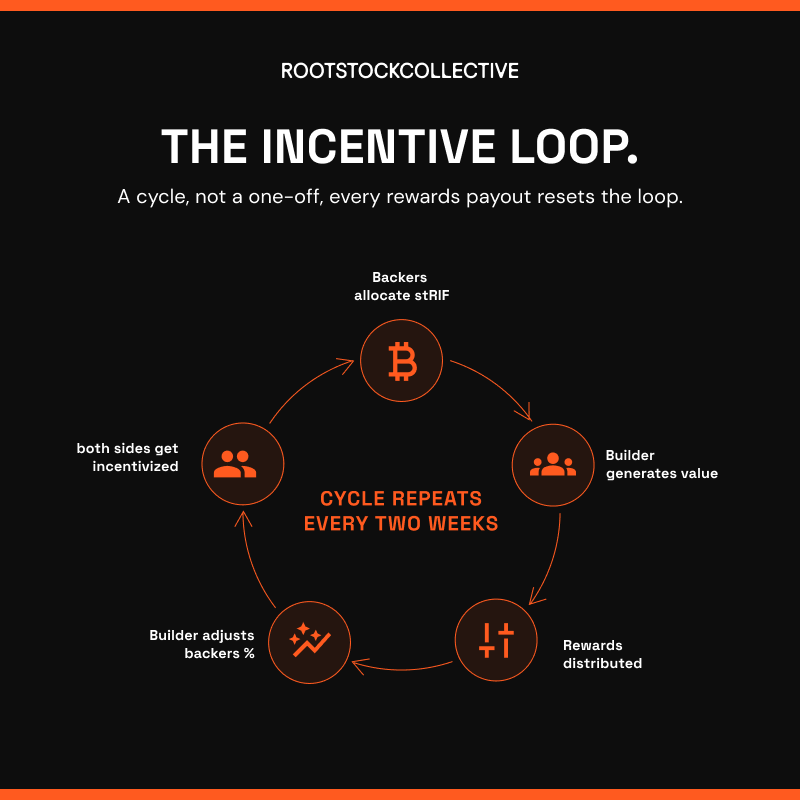
Rewards are paid in rBTC, RIF, or USDRIF, claimable every two weeks from “My Collective” in the dApp.
RIF (via stRIF) is also what lets the community fund the projects expanding Rootstock. There are two distinct, complementary tracks:
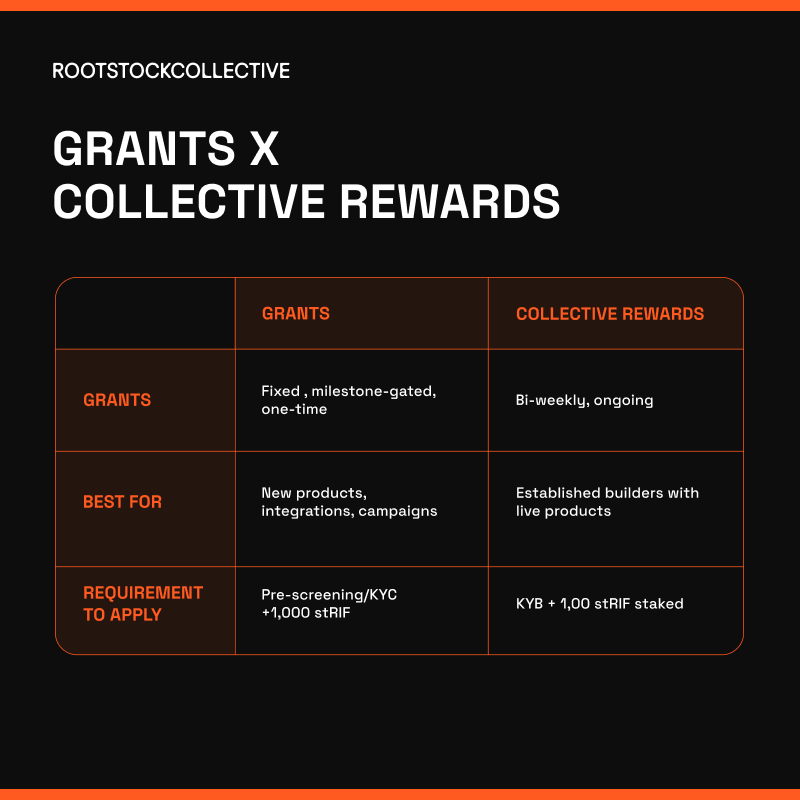
Many builders use a grant to launch, then activate for Collective Rewards once their product is live and generating real activity, RIF governance underpins both tracks.
RIF also functions as collateral. Lock RIF (and rBTC) to mint USDRIF, a USD-pegged stablecoin that’s 6× overcollateralized and native to Rootstock. USDRIF is built for:
Note: USDRIF is geofenced and currently unavailable to US persons or sanctioned/restricted jurisdictions.
RIF powers the RIF Name Service (RNS), letting anyone register a human-readable .rsk username instead of a long wallet address, similar to Ethereum’s ENS. It’s a small but meaningful utility that makes transacting on Rootstock more intuitive for everyday users.
Beyond USDRIF, RIF is usable directly across Rootstock’s DeFi layer, as a liquidity pair, a lending/borrowing asset, or a yield-bearing deposit on platforms like Sovryn, SushiSwap, WoodSwap, Beefy, and ICHI. This is where RIF’s utility extends past governance into everyday, permissionless finance.
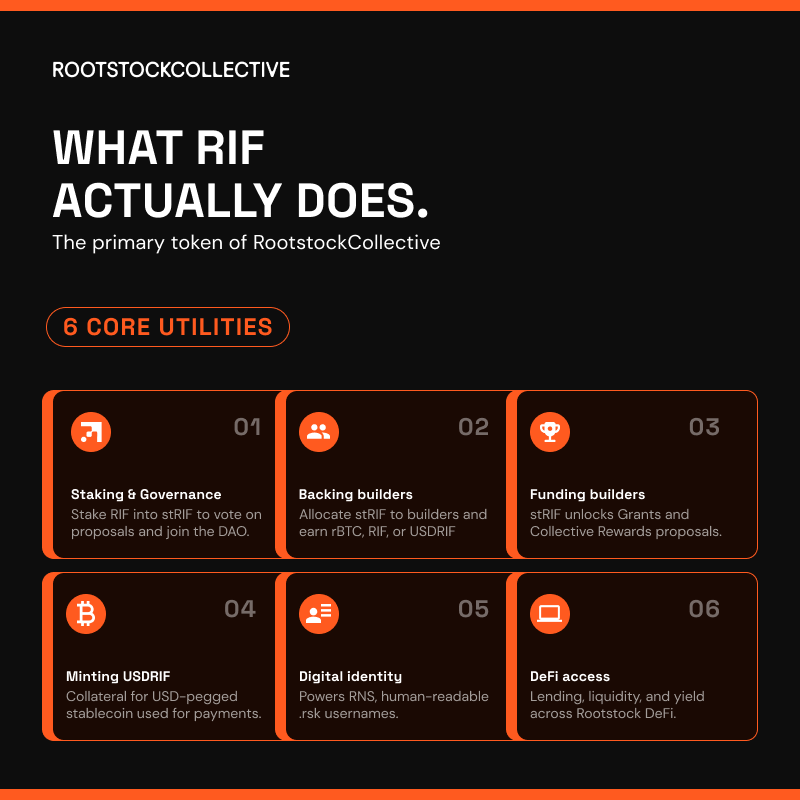
Each one of these utilities feeds back into the same loop: RIF holders stake into governance, direct capital toward builders, and those builders create the real DeFi, payments, identity, and infrastructure activity that gives Bitcoin, via Rootstock, more utility. The healthier that loop is, the more the Collective, and every participant in it, has to gain.