


If you’ve heard about RootstockCollective but still think of RIF as “just another token to hold,” this article is for you. RIF isn’t a passive asset, it’s the working key that unlocks every door in the Rootstock ecosystem: governance, rewards, stablecoins, identity, and DeFi.
Below is the complete map of what RIF actually does, and how each utility connects back to the health of the Collective.
Before getting into the specific use cases, it’s worth anchoring the big picture: RIF is the primary token of RootstockCollective. It’s the single asset that ties the whole system together:
In short: RIF is what turns a Rootstock user into a Collective participant.
One of RIF’s core functions. Stake RIF in the RootstockCollective dApp to receive stRIF, your seat at the governance table. Without it, you can observe the DAO but not participate in it.
With stRIF you can:
Staking isn’t passive; it’s an active allocation decision. Backers (stRIF holders) direct their stake toward the builders they want to see succeed. Builders set a Backer Reward % to make their project more attractive to backers; the more ecosystem value a builder generates, the more backing – and the more rewards – flow to everyone involved.
This creates a straightforward incentive loop:
Builder generates value → Backers allocate stRIF → Rewards distributed → Builder adjusts Backer % → Both sides get incentivized
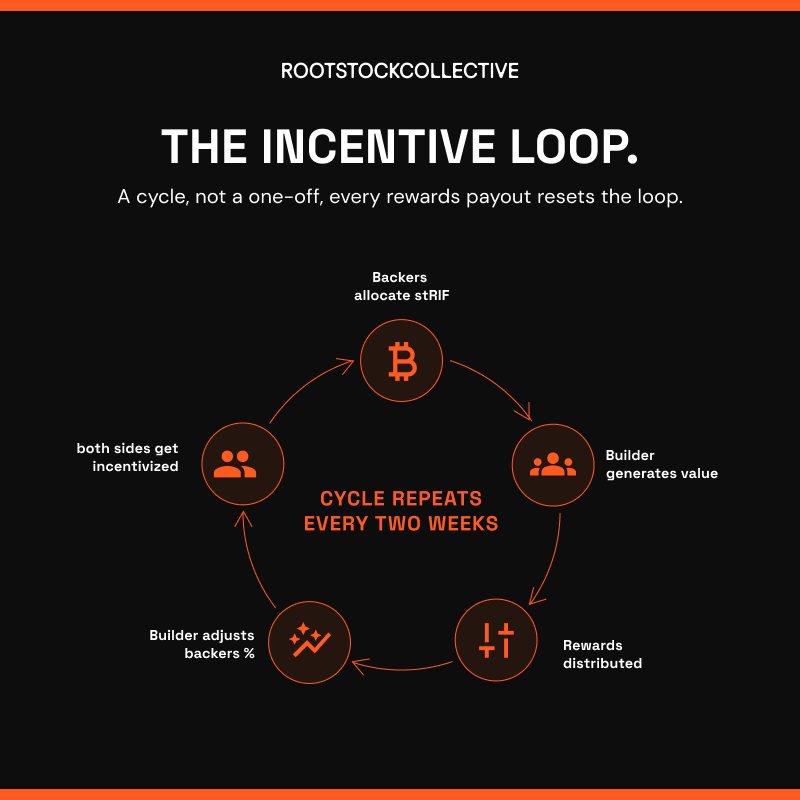
Rewards are paid in rBTC, RIF, or USDRIF, claimable every two weeks from “My Collective” in the dApp.
RIF (via stRIF) is also what lets the community fund the projects expanding Rootstock. There are two distinct, complementary tracks:
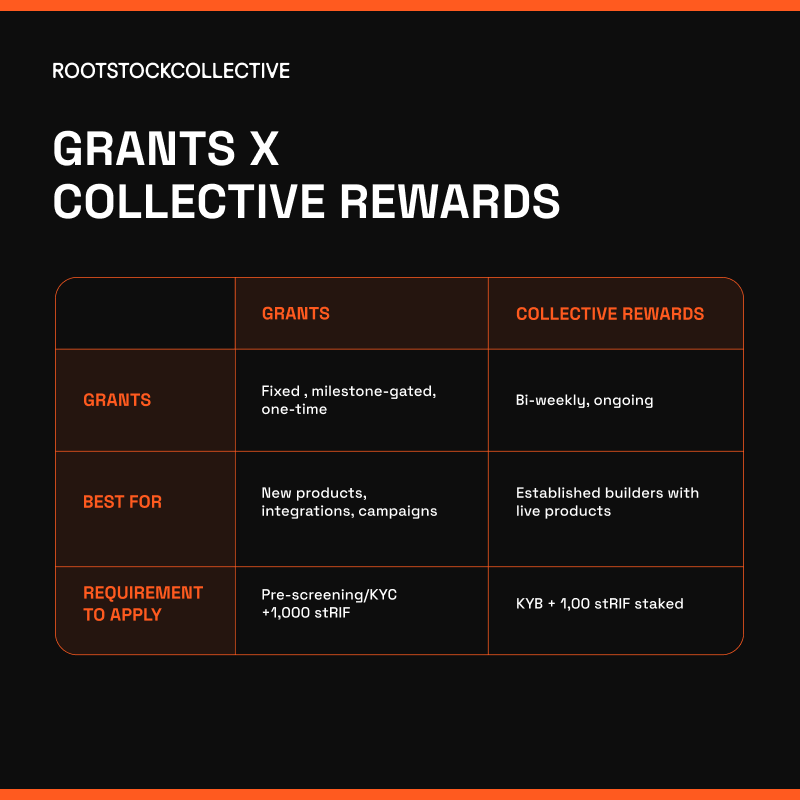
Many builders use a grant to launch, then activate for Collective Rewards once their product is live and generating real activity, RIF governance underpins both tracks.
RIF also functions as collateral. Lock RIF (and rBTC) to mint USDRIF, a USD-pegged stablecoin that’s 6× overcollateralized and native to Rootstock. USDRIF is built for:
Note: USDRIF is geofenced and currently unavailable to US persons or sanctioned/restricted jurisdictions.
RIF powers the RIF Name Service (RNS), letting anyone register a human-readable .rsk username instead of a long wallet address, similar to Ethereum’s ENS. It’s a small but meaningful utility that makes transacting on Rootstock more intuitive for everyday users.
Beyond USDRIF, RIF is usable directly across Rootstock’s DeFi layer, as a liquidity pair, a lending/borrowing asset, or a yield-bearing deposit on platforms like Sovryn, SushiSwap, WoodSwap, Beefy, and ICHI. This is where RIF’s utility extends past governance into everyday, permissionless finance.
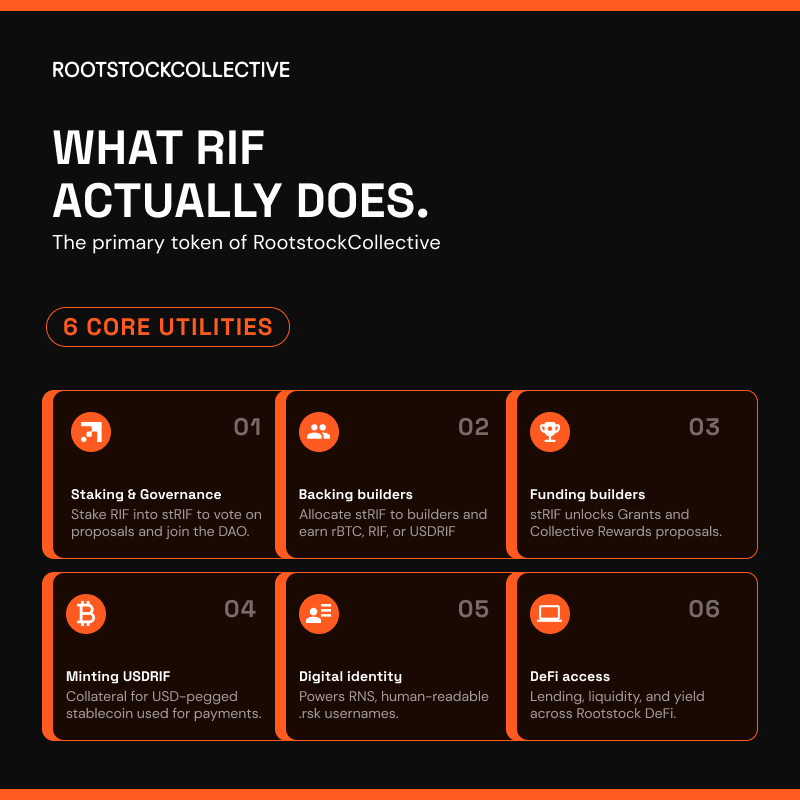
Each one of these utilities feeds back into the same loop: RIF holders stake into governance, direct capital toward builders, and those builders create the real DeFi, payments, identity, and infrastructure activity that gives Bitcoin, via Rootstock, more utility. The healthier that loop is, the more the Collective, and every participant in it, has to gain.