


Bitcoin was built to move value freely, but for years it lacked the programmable logic needed to power modern fundraising: escrow, conditional release, fee routing, recurring splits. Geyser, a Bitcoin crowdfunding platform that has powered creators and humanitarian causes for over three years, set out to close that gap.
Their journey , from first Rootstock grant to now-activated Collective Rewards builder, is one of the clearest examples yet of how RootstockCollective is designed to work: fund an idea, prove it in production, then reward the builders who keep showing up.
Geyser’s founders, Stelios and Mick, didn’t set out to build “just another crowdfunding site.” Traditional platforms are custodial, geographically restricted, and dependent on legacy payment rails. Geyser wanted to give creators something different: global access to funding, direct settlement, and real control over their money, all without a middleman holding the funds.
Bitcoin was the obvious foundation. But Bitcoin and Lightning alone don’t easily support the kind of conditional logic crowdfunding needs. Think campaigns that only release funds if a goal is hit, or ongoing fundraisers that split incoming payments automatically. That’s where Rootstock came in.
“Rootstock gives us a business-logic layer for Bitcoin applications, while keeping the experience non-custodial,” the team explains.
Rootstock lets Geyser verify payments, route funds, and apply variable fee logic, all secured by a Bitcoin-aligned network, without asking users to hold funds on a separate chain.
Geyser’s first move into the Rootstock ecosystem was a grant application to build All-or-Nothing (AON) crowdfunding, a simple idea with a hard non-custodial constraint: a creator sets a funding goal and deadline; if the goal is reached, funds are released; if it isn’t, contributors can reclaim their money automatically, with Geyser never taking custody along the way.
The $26,000 grant was structured across three milestones: $10,000, $10,000, and $6,000, each tied to concrete development, launch, and adoption deliverables. The team describes the process as generally smooth, crediting the Rootstock team for helping translate their idea into clear technical checkpoints.
The real challenge wasn’t the grant process, it was the product itself: “Users should not need to understand contracts, gas, or network mechanics, nor hold Bitcoin on a separate chain. So much of the work was about hiding that complexity without compromising transparency or custody.”
AON went live on Rootstock mainnet in January 2026. The grant was completed across all three milestones by mid-2026, a working, non-custodial crowdfunding primitive, live in production.
AON solved fundraising for campaigns with a clear goal and deadline. But a large share of Geyser’s activity comes from projects that raise funds continuously, with no fixed target. That gap led to Prism, a contract enabling programmable payment routing and fee logic for open, ongoing fundraising, deployed on Rootstock mainnet in April 2026.
Together, AON and Prism cover both ends of the fundraising spectrum: goal-based campaigns and continuous funding streams, both non-custodial, both transparent on-chain.
Real projects put these tools to work. Proof of Work, We Satoshis, and WallAxe are among the Bitcoin-native projects that have raised funds through Geyser using its Rootstock integration, concrete proof that this wasn’t infrastructure built for its own sake.
The numbers tell the same story. Rootstock-attributable volume through Geyser grew from roughly 0.013 RBTC in December 2025 to 1.16 RBTC by May 2026, with active wallets climbing from 2 to 46 over the same stretch, and all-time volume across AON and Prism reaching 2.29 RBTC. Asked which metric they’re proudest of, the team didn’t hesitate: “The 2.29 RBTC in volume is the most meaningful metric because it represents real economic activity. The goal was not simply to deploy contracts, but to have people use them for genuine contributions.”
Completing a grant is often where a builder’s relationship with an ecosystem ends. For Geyser, it was the beginning of a new one. In July 2026, Stelios and Mick submitted a Builder Activation proposal to join RootstockCollective’s Collective Rewards program, and it was accepted by the community, with an initial Backer Reward of 72%.
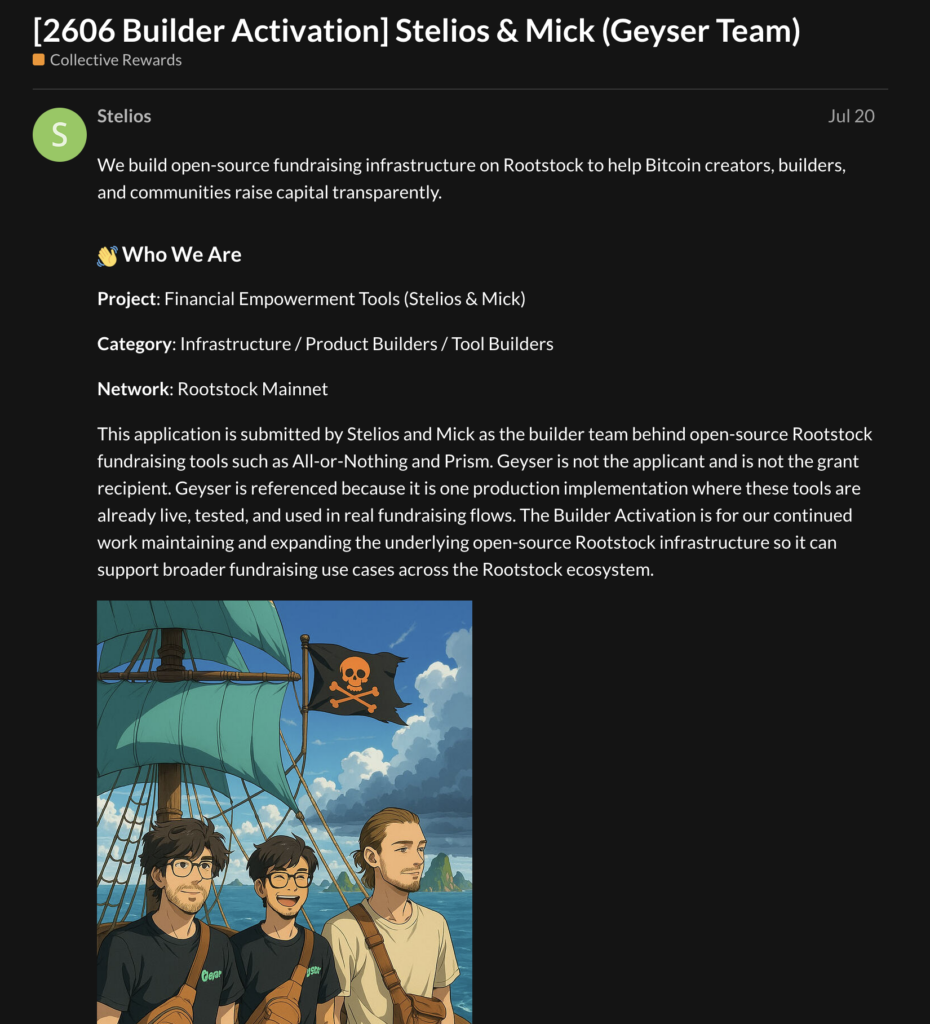
The distinction between the two programs matters, and the team is clear about it: “The grant helped finance the initial build. Collective Rewards offered a way for the ecosystem to support continued usage and development based on the value our team brings to Rootstock over time.” Where the grant funded a defined experiment with fixed milestones, Collective Rewards is open-ended and performance-driven, rewarding continued adoption, transaction volume, and ecosystem contribution rather than a one-time deliverable.
It’s a natural design: grants get an idea built and proven; Collective Rewards keeps the builders who deliver real, ongoing value backed by the community that benefits from it.
Geyser’s contracts are open source, meaning other builders can use them as references or building blocks for their own fundraising flows. That said, the team is candid that their immediate focus remains Geyser itself rather than pushing AON or Prism as a standalone product, though they remain open to supporting any developer looking to build on what they’ve created.
Being part of RootstockCollective has shaped more than just their funding, it’s shaped how they think. “It has encouraged us to think beyond shipping a contract and focus more on sustained usage and marketing/growth efforts. It also creates a closer feedback loop between builders, backers, and the wider Rootstock community.”
Looking ahead, Geyser plans to keep using Rootstock where it adds real functionality , payment verification, flexible fee logic, fund routing, wherever no good alternative exists for builders trying to solve the same problems. As they put it: “The real value of Rootstock is not complexity for its own sake. It is enabling essential product functionality that Bitcoin payments alone cannot easily provide.”
Asked what they’d tell a team considering the same path, the answer was direct: “Apply with a clear user problem, not simply a reason to deploy a contract. Use the grant to build and validate something concrete, then consider Collective Rewards if you can demonstrate ongoing value and adoption.”
That’s the blueprint RootstockCollective was designed to create, and Geyser is now living proof that it works: identify a real problem, get backed to build it, prove it in production, and grow alongside the community that helped fund it.
Geyser’s journey from grant to Collective Rewards builder is exactly the kind of growth RootstockCollective exists to support, and there’s a place for you in it, whether you’re building or backing.